

Downloadable templates are one of the more durable formats for earning editorial backlinks because they solve a specific, recurring problem for a defined audience. When a template genuinely saves time or reduces complexity, other websites reference it naturally — and those references can accumulate over months or years without additional outreach investment. This article explains how the strategy works, which template formats tend to attract links, how to combine passive link earning with active promotion, and what realistic expectations look like for businesses considering this approach.
Key Takeaways
- Downloadable templates earn backlinks by providing genuine utility — links accumulate when other content creators reference the resource as a practical tool for their audience.
- Template-based link acquisition works best when the format is tightly matched to a specific audience problem and is supported by active outreach rather than passive publishing alone.
- Earning links through templates is a medium-to-long-term strategy; most pages take several months to accumulate meaningful referring domains, and results depend heavily on niche competition and promotion effort.
- Template assets can complement other link building methods such as guest posting and digital PR, but they are unlikely to replace a full link acquisition programme for competitive industries.
- Quality control matters: a poorly designed or inaccurate template can attract low-quality links or damage brand credibility rather than support it.
Why Templates Attract Backlinks
Backlinks earned through downloadable resources belong to a broader category often called linkable asset creation or resource-based link building. The underlying mechanism is straightforward: when a piece of content provides enough standalone value that other writers, editors, or website owners want to reference it, those references become editorial backlinks. Templates occupy a particularly useful position in this ecosystem because they are functional rather than purely informational. A well-structured content calendar template, an SEO audit checklist, or a link building outreach tracker gives the user something they can open, adapt, and use immediately — which makes it more likely to be bookmarked, shared, and cited.
From a search-engine perspective, editorial backlinks earned because a resource is genuinely useful are generally considered higher quality than links acquired through paid placements or reciprocal arrangements, because they reflect an independent editorial decision. This does not mean template-based links are automatically valuable; the quality of the linking page, its topical relevance, and the context of the link all influence how much weight a backlink may carry. A link from a relevant industry blog with an established audience is likely to be more meaningful than a link from a low-traffic directory that lists free downloads indiscriminately.
Template Formats That Tend to Earn Links
Not every downloadable file attracts backlinks. The formats most likely to earn editorial references share a common characteristic: they reduce a meaningful amount of work for a specific, identifiable audience. The following categories have demonstrated consistent link-earning potential across a range of industries.
Spreadsheet and Tracker Templates
Spreadsheet templates — particularly those built in Google Sheets or Microsoft Excel — earn links because they replace manual setup time. An SEO keyword tracking spreadsheet, a backlink audit template, or a content production tracker gives a practitioner a working tool rather than a concept to implement themselves. Writers producing tutorials or how-to guides frequently link to a ready-made spreadsheet rather than asking their readers to build one from scratch. The link is functional: it serves the reader of the linking article, which is why editors are willing to include it.
Document and Report Templates
Structured document templates — such as SEO proposal templates, monthly reporting frameworks, or link building campaign briefs — attract links from agency blogs, marketing publications, and professional development resources. These templates tend to earn links from higher-authority domains because the linking content is often produced by experienced practitioners who are writing for a professional audience. The trade-off is that document templates require more careful design and accuracy; an error in a reporting template, for example, can undermine credibility quickly.
Checklist and Process Templates
Checklists earn links because they compress expertise into a scannable, reusable format. A technical SEO audit checklist, a pre-launch website review, or a link prospecting checklist can be referenced repeatedly in articles covering the same process. Checklists also tend to perform well in search results for procedural queries, which increases organic discovery and the likelihood of additional links over time.
Interactive and Calculable Templates
Templates that include formulas, conditional logic, or interactive elements — such as a link building ROI estimator or a content gap analysis framework — attract links because they provide a calculation or output that would otherwise require manual effort. These are more resource-intensive to produce but can earn links from a wider range of content types, including data-driven articles and industry roundups.
Building a Template That Earns Links: Practical Considerations
Creating a downloadable template and publishing it on a resource page is not sufficient on its own. Several factors influence whether a template earns backlinks at a meaningful rate.
Audience and Problem Specificity
Templates that try to serve everyone tend to serve no one particularly well. A generic project management template competes with thousands of similar assets from established platforms. A link building campaign tracker designed specifically for SEO agencies managing multiple clients occupies a narrower space with a more defined audience — and is more likely to be referenced by the blogs, newsletters, and resource pages that audience reads. Specificity also makes outreach easier: it is straightforward to identify the websites and writers who would genuinely benefit from recommending the template to their readers.
Accuracy and Usability
A template that contains errors, unclear instructions, or a confusing structure will not earn sustained links regardless of how well it is promoted. Before publishing, the template should be tested by someone unfamiliar with its creation — ideally a representative of the target audience — to identify gaps in usability. Accuracy is particularly important for templates involving calculations, compliance requirements, or professional processes, where an error could mislead users and reflect poorly on the linking site as well as the publisher.
Landing Page Quality
The page hosting the template is itself a ranking and conversion asset. A well-structured landing page that explains what the template does, who it is for, what problem it solves, and how to use it gives search engines enough context to rank the page for relevant queries. It also gives potential linkers enough information to decide whether the resource is worth recommending. A bare download link with no surrounding content is unlikely to attract organic links or rank for discovery queries.
Access and Friction
Whether to gate a template behind an email sign-up or offer it freely affects link acquisition. Gated templates can generate leads but reduce the likelihood of editorial links, because writers and editors are less likely to recommend a resource that requires their readers to submit personal information. Freely accessible templates earn more backlinks on average, though the right approach depends on the business goal. Some organisations offer a free preview version for link acquisition and a more comprehensive gated version for lead generation.
Active Promotion: Combining Templates with Outreach
Passive link earning — waiting for other websites to discover and reference a template organically — is slow and unpredictable, particularly for newer domains or less-established brands. Active promotion significantly accelerates the process and is generally necessary to build a meaningful backlink profile from template assets within a reasonable timeframe.
Manual Outreach to Relevant Publishers
Manual outreach involves identifying websites, blogs, and resource pages that cover topics related to the template’s subject matter, then contacting the editors or authors to suggest the template as a useful addition to their existing content. Effective outreach is personalised, explains the specific value the template offers to the publisher’s audience, and does not read as a generic link request. The response rate for well-targeted, personalised outreach is typically higher than for mass-sent campaigns, and the links earned tend to come from more relevant, higher-quality pages.
Outreach for template-based link acquisition often targets three types of pages: existing resource roundups or tools lists that already link to similar assets; how-to articles or tutorials that explain a process the template supports; and comparison or review articles where the template could be cited as a practical tool. Each of these page types has a different outreach angle and a different likelihood of editorial inclusion.
Broken Link Building with Templates
Broken link building is a complementary tactic: identifying pages that link to similar templates or resources that are no longer available, then suggesting the published template as a replacement. This approach works because it offers the linking site a genuine editorial benefit — replacing a broken reference — rather than simply asking for a link. The tactic requires systematic prospecting using tools such as Ahrefs or Semrush to identify broken outbound links on relevant pages, which adds to the time investment but can produce links from pages that are already editorially inclined to reference this type of resource.
Digital PR and Content Syndication
For templates with broad industry relevance, digital PR outreach — pitching the template to journalists, newsletter editors, and industry publications — can generate links from high-authority domains that would be difficult to reach through standard outreach. This approach works best when the template is tied to a data point, a trend, or a practical need that is currently relevant to the publication’s audience. A link building outreach rate benchmark template, for example, might be pitched alongside original data about outreach response rates in a specific industry.
Integrating Templates into a Broader Link Building Campaign
Template-based link acquisition is most effective when it forms part of a broader link building strategy rather than operating in isolation. A standalone template page may earn a modest number of links over time, but combining it with guest posting, niche edits, and digital PR creates a more diverse and resilient backlink profile.
Guest posts on relevant industry blogs can reference the template directly, generating both a backlink to the template page and additional exposure to a new audience. Niche edits — adding a reference to the template within existing, already-indexed articles — can place the asset in front of readers who are actively searching for the type of resource it provides. These methods work together: the template earns passive links over time while outreach and content placement accelerate the initial accumulation of referring domains.
For agencies managing link building campaigns on behalf of clients, downloadable templates can serve as linkable assets that support multiple target pages simultaneously. A well-designed template hosted on a client’s domain can attract links that pass authority to the root domain, benefiting other pages indirectly. This makes template creation a potentially efficient investment for clients with limited content budgets, provided the template is genuinely useful and well-promoted.
Realistic Timelines and What to Expect
Template-based link acquisition is not a fast strategy. Most newly published template pages take several months to begin accumulating organic links, even with active outreach. The timeline depends on several factors: the competitiveness of the niche, the quality and specificity of the template, the authority of the publishing domain, the volume and quality of outreach, and whether the template page ranks for relevant discovery queries.
In less competitive niches with targeted outreach, a well-designed template page might earn its first handful of referring domains within six to twelve weeks of publication. In more competitive industries, or for domains with limited existing authority, the same timeline may produce fewer results, and a sustained outreach effort over six months or more may be required before the backlink profile becomes meaningful. These are general observations rather than guarantees; individual results depend on the specific website, market, and campaign execution.
It is also worth noting that earning backlinks does not automatically translate into ranking improvements or traffic increases. Rankings depend on many factors beyond the backlink profile, including content quality, technical SEO health, search intent alignment, and the strength of competing pages. A template page that earns twenty referring domains may see measurable ranking movement for its target queries, or it may not, depending on these broader factors. Monitoring the page’s performance in Google Search Console alongside third-party tools such as Ahrefs or Semrush can help identify whether the links being earned are contributing to visibility over time.
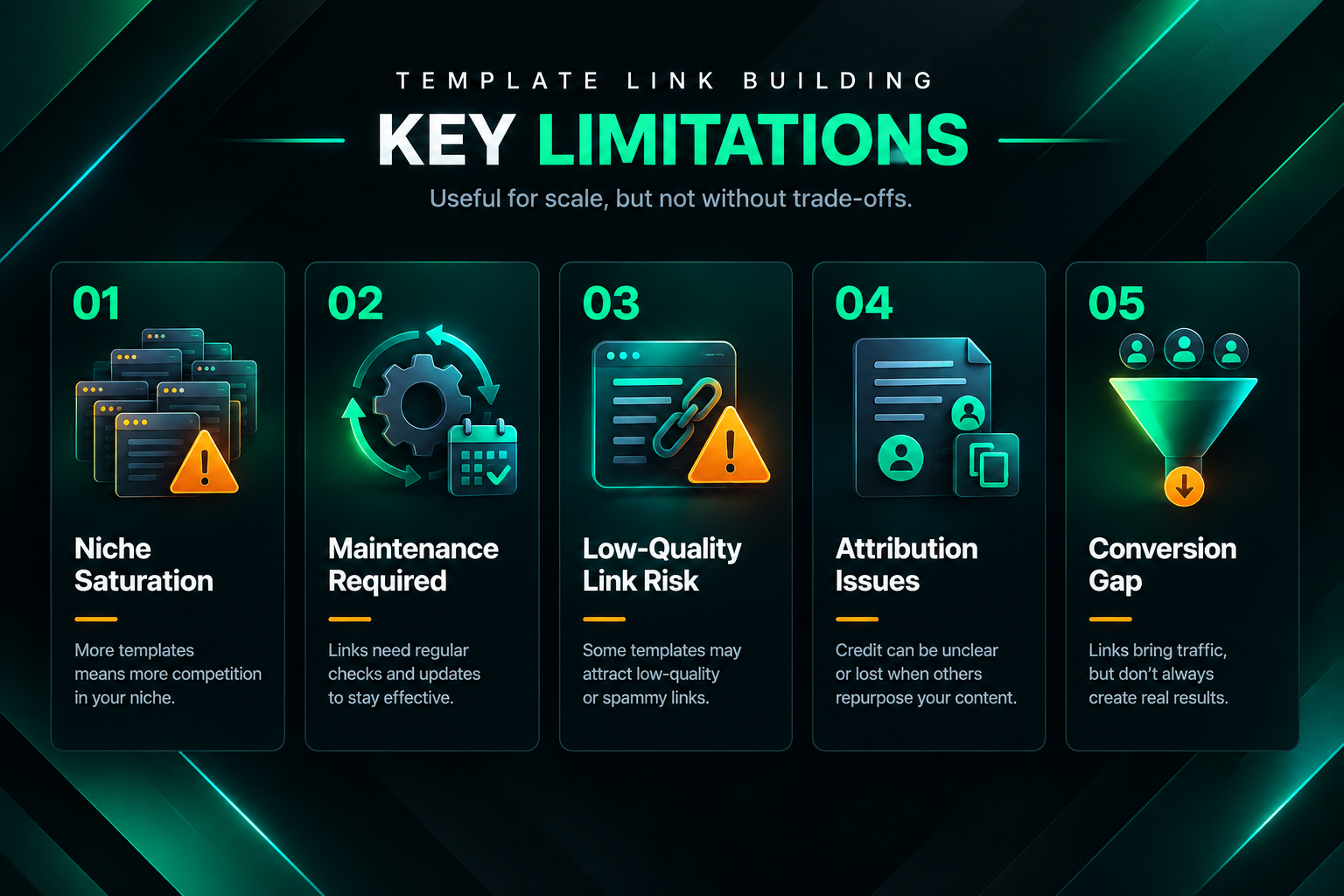
Limitations and Risks
Template-based link building has genuine limitations that are worth understanding before committing significant resources to the approach.
- Saturation in popular niches: In well-established content marketing, SEO, and project management niches, high-quality free templates already exist in abundance. A new template must offer a meaningful improvement over existing options to earn links rather than being ignored.
- Maintenance requirements: Templates can become outdated as tools, platforms, or industry practices change. An outdated template may lose links over time as linking sites update their content or remove references to resources that are no longer accurate.
- Low-quality link risk: Freely available templates can attract links from low-quality directories, content farms, or irrelevant sites that aggregate free resources indiscriminately. These links are unlikely to provide SEO benefit and may require periodic monitoring and disavowal consideration.
- Attribution and copying: Popular templates are sometimes copied and republished without attribution, which can dilute the link-earning potential of the original asset and create duplicate content concerns if the copied version ranks competitively.
- Conversion dependency: For businesses whose primary goal is lead generation or sales, a freely accessible template may generate links without generating qualified leads, particularly if the template audience does not overlap closely with the buyer audience.
Who May Benefit Most from This Approach
Template-based link acquisition may be particularly suitable for businesses and organisations in the following situations. It is not universally appropriate, and a site-specific assessment is advisable before committing to a template-led strategy.
- SaaS companies and software tools whose product solves a workflow problem — a template that demonstrates the problem the software addresses can attract links from the same audience the product targets.
- Marketing agencies and consultancies that can publish professional-grade templates demonstrating their expertise, attracting links from industry publications and potential clients simultaneously.
- E-commerce businesses in niches where buyers use planning tools — a home renovation cost estimator or a wedding planning checklist, for example, can attract links from lifestyle and planning content.
- Established domains with existing authority that want to diversify their backlink acquisition methods beyond outreach-only campaigns.
- Businesses with in-house content teams capable of producing, maintaining, and promoting template assets over time.
Businesses with very new domains, limited content resources, or highly transactional niches where template content has little natural audience may find that other link building methods — such as targeted guest posting or digital PR — deliver more predictable results for the investment involved.
Frequently Asked Questions
How many backlinks can a downloadable template realistically earn?
There is no reliable universal figure. A highly specific, well-promoted template in a niche with active content production might earn dozens of referring domains over twelve months. A generic template in a saturated category might earn very few. The number of links earned depends on template quality, niche competition, domain authority, and the volume and quality of outreach. Tracking referring domain growth in a tool such as Ahrefs or Semrush over time gives a more accurate picture than any pre-campaign estimate.
Should the template be gated or freely accessible?
Freely accessible templates generally earn more backlinks because writers and editors are more willing to recommend resources their readers can access without friction. Gated templates are better suited to lead generation goals. Some businesses offer a free basic version for link acquisition and a more comprehensive version behind a sign-up form, which can serve both objectives simultaneously.
What file format works best for a linkable template?
Google Sheets and Excel spreadsheets are widely linked because they are immediately usable without additional software. PDF checklists and process documents are also commonly referenced. The best format depends on the template’s function: a tracker or calculator works best as a spreadsheet, while a reporting framework or proposal template may work better as a structured document. Hosting the template on a dedicated landing page — rather than linking directly to a file — gives the page a better chance of ranking and being discovered organically.
How does template-based link building compare to guest posting?
Guest posting places content — and a backlink — on an external publisher’s website, giving the linking site editorial control over placement and anchor text. Template-based link building earns links to a page on the publisher’s own domain, with less control over when or how links appear. Guest posting tends to produce more predictable short-term results; template-based link acquisition can produce compounding returns over time if the asset continues to attract links passively. Many effective link building campaigns use both methods in combination.
Can templates earn links without active outreach?
Passive link earning is possible but slow, particularly for newer domains. A template page that ranks well for relevant discovery queries — such as “free SEO audit template” or “link building tracker spreadsheet” — can attract organic links from writers who find it through search. However, reaching those rankings typically requires some initial links, creating a dependency on outreach or other promotion methods to build early momentum.
How do I assess whether the links a template earns are good quality?
Useful indicators include the topical relevance of the linking page to the template’s subject matter, the organic traffic and authority of the linking domain (using tools such as Ahrefs Domain Rating or Semrush Authority Score as proxies, not guarantees), whether the link appears in editorial content rather than a footer or sidebar, and whether the anchor text is descriptive and contextually appropriate. Links from low-traffic, irrelevant, or heavily commercial pages are less likely to contribute meaningfully to search visibility.
Deciding Whether a Template Strategy Fits Your Link Building Goals
Downloadable templates can be a genuinely effective component of a link acquisition strategy, particularly for businesses that can produce high-quality, audience-specific assets and support them with consistent outreach. The approach rewards specificity, accuracy, and sustained promotion — and it tends to underperform when templates are generic, poorly designed, or published without a clear plan for getting them in front of relevant publishers and audiences.
The strategy is not a shortcut. Building a meaningful number of referring domains through template assets typically takes months of combined content production, outreach, and monitoring. For businesses in competitive industries or with limited existing domain authority, template-based link acquisition is likely to be most effective as part of a broader campaign that also includes guest posting, niche edits, or digital PR rather than as a standalone approach.
If you are considering whether a template-led link building strategy is appropriate for your website and goals, a qualified SEO provider can assess your existing backlink profile, identify realistic opportunities, and recommend a combination of methods suited to your niche, domain history, and target pages. The right approach depends on factors specific to your website — and a site-specific assessment is a more reliable starting point than any general prescription.


